
London’s most historic pubs rarely exist by accident.
Quiet backstreet locals have their charm, spades of it. But they are rarely burdened with much of a story beyond a simple survival tale, or a dodgy regular that’s graced their bar stools.
The ones that matter tend to appear where paths cross, movement slows, and folk are forced to wait long enough for a pint, or something stiffer.
Coaching roads, river crossings, staging posts, train stations and, in more modern times, though admittedly lacking the history, airports.
Where people are made to wait, often with a few hours to kill, a drink has always been the most obvious solution for anyone not of the dullest of complexion.
With coaching roads there were many. Train stations after the 1850’s became a pound a dozen. Even though there was one river, crossing points were plenty.
But for centuries there was one choke point on any journey into the city and it gave us one of the most interesting public houses London has ever known.
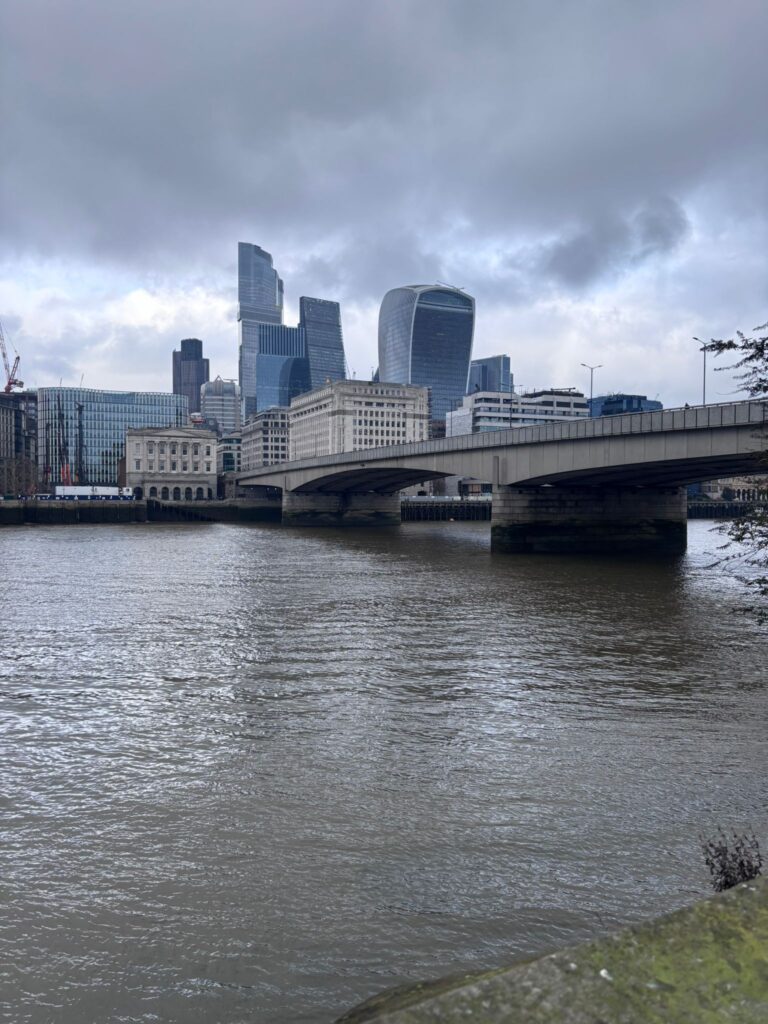
London’s existence owes itself to London Bridge. It was here that the Thames narrowed, making it an attractive place for the Romans to settle on the northern bank of the river. A bridge soon followed, around AD 40, and from then until 1750 it remained the only fixed way to cross the Thames without dancing with the deep, dark water below.
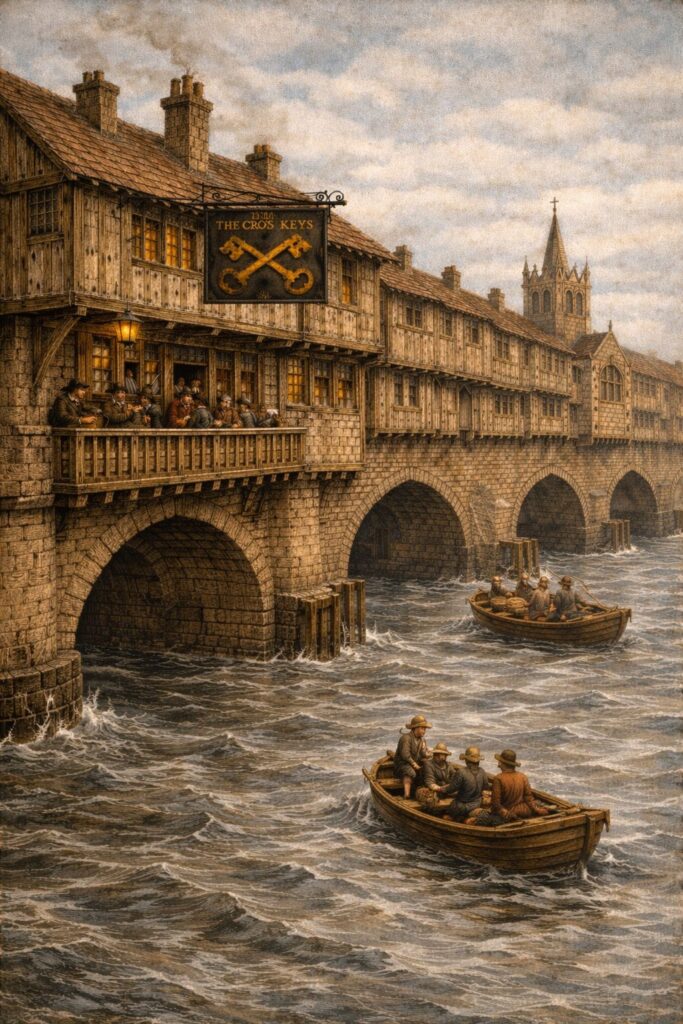
The first stone bridge, completed in 1237 and hailed as a marvel of the medieval world, became such a focal point that a fully functioning village took hold upon it. More than 400 people lived there. It had houses, stables, shops, a chapel and of course, a public house: the Crosse Keys.
It sat directly above the river, on the bridge’s narrow roadway, the only way in or out of London from the south, a choke point of all choke points.
Weary travellers, with the church spires of the City tantalisingly close, often faced near gridlock for hours as horses, carts, and porters trundled along the cobbles on the final leg of their journey.
For many, it must have become a ritual, la rite of passage perhaps, to stop in the Cross Keys for an ale before entering the City proper.
Look out the front and you’d have been greeted with sheer chaos: horses, carts, porters, mud, animal waste, and raised voices echoing between the timbered dwellings.
Look out the back and the river opened up below you. The Thames, London’s lifeblood, its water source, its sewer, its superhighway. Watermen ferried passengers across the wicked eddys, lightermen hauled goods between wharves, and ships from across the world arrived laden with cargo: spices from India, tobacco from the Caribbean, and everything else you could imagined.
Wherever you looked, the scene would have been movement, noise, and disorder. The entire city passing beneath, beside, and through a single pub.
By 1757, the Cross Keys became a victim of the same force that has claimed so many London boozers before and since: redevelopment.
All the buildings atop London Bridge were dismantled and the carriageway widened to ease the traffic. The houses went. The chapel went. The pub went.
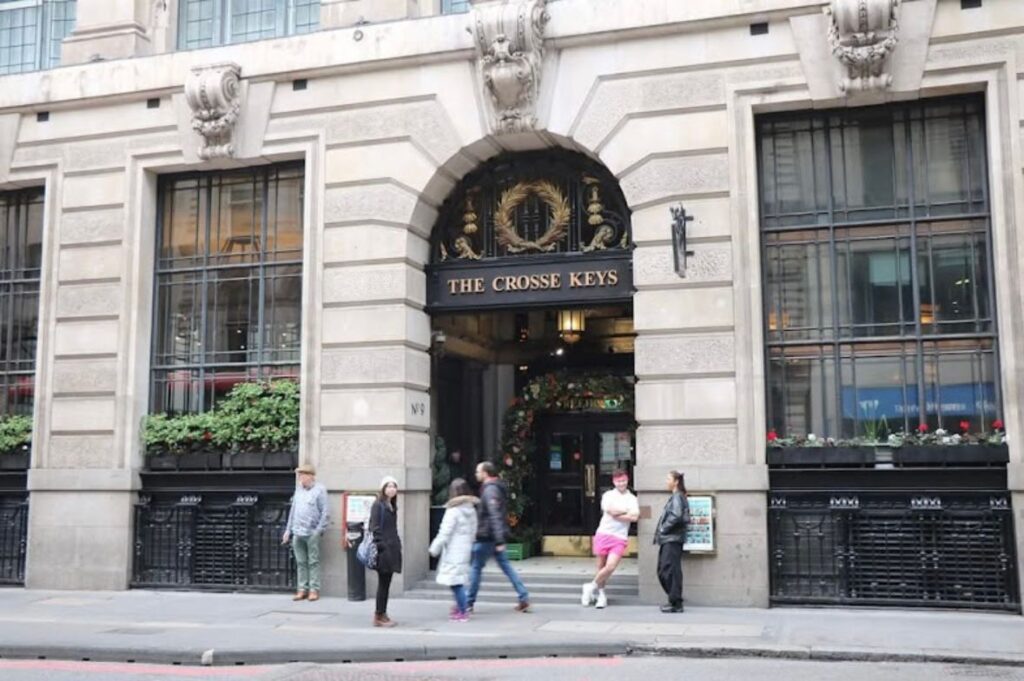
But its existence had never been an accident. For centuries, London Bridge was the ultimate bottleneck the primary crossing everyone had to use. And where people are forced to wait, a pub is never far behind.
Long before station concourses and airport lounges, old London Bridge had its own answer to the problem of killing time.
It was called the Crosse Keys.